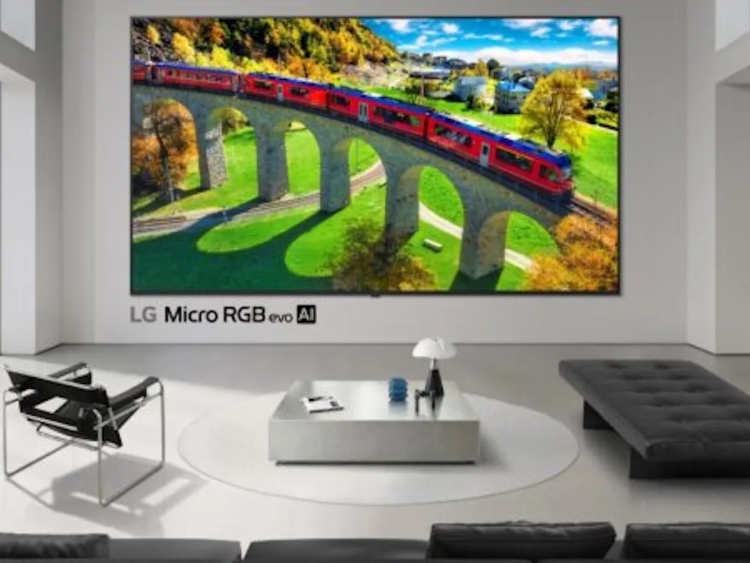
Despite the name, this is not Micro LED in the self-emissive sense pushed by Samsung, but LG’s spin on RGB Mini LED, a technology already teased by Sony, Samsung and TCL. Hisense has even shipped it as the 116UX, so this horse has already left the stable.
The core trick is stuffing red, green and blue LEDs directly into the backlight, rather than relying on LCD colour filters or Quantum Dot layers. LG reckons ditching those filters boosts gamut coverage, brightness and contrast, at least on the spec sheet.
LG claims the MRGB95 packs “more than a thousand dimming zones with exceptional accuracy.”
That is miles away from OLED’s per-pixel control, but decent enough by backlit standards where processing usually matters more than raw numbers.
Key to the whole thing is the Alpha 11 Gen 3 processor, which, for the first time, breaks free of OLED captivity.
LG says this “uses OLED precision to control each of the RGB LED backlights, bringing 13 years of LG OLED’s technical excellence to the RGB category.”
There is a new badge called RGB Primary Colour Ultra, which appears to mean “look how colourful this is.”
LG claims 100 per cent coverage of BT.2020, DCI-P3 and Adobe RGB, which sounds lovely until you remember how wildly picture modes skew reality.
If true, it would still be impressive, but no TV hits those numbers in its lurid out-of-the-box vivid mode. Calibration, as ever, will separate marketing from reality.
Upscaling is another talking point, with something LG calls Dual Super Upscaling running two AI processes at once. This matters because the MRGB95 only comes in monster sizes of 75, 86 and 100 inches.
LG is staying coy on HDMI 2.1 ports, though the Alpha 11 can handle 4K at 165Hz for gamers. You would hope for at least four sockets, matching the C5 and G5, but hope is doing some heavy lifting here.
Pricing and launch dates remain a mystery, but that hasn't stopped the hype machine from whirring. What makes it interesting is that others who have seen similar tech are quietly impressed.
What Hi Fi's TV and AV editor, Tom Parsons, said: “I was hugely impressed by Sony’s RGB LED prototype. Sony could indeed have been masking some flaws (there was no demonstration in a pitch-black room, for example). Still, the upgrades over the Bravia 9 and my beloved A95L were so stark, and the apparent downsides so hard to spot, that I can’t help but be really excited for the tech to go on sale.”
None of this means OLED is dead, no matter how much marketing would like that to be true. It means LG is hedging its bets with brighter panels, bigger screens and a fresh badge to keep the excitement bubbling.